
Custom Walkways for RI & MA Homes
Front paths and garden walks in paver, bluestone and cobblestone, level and slip-aware through every season.
Or call (401) 258-1789
Walkways
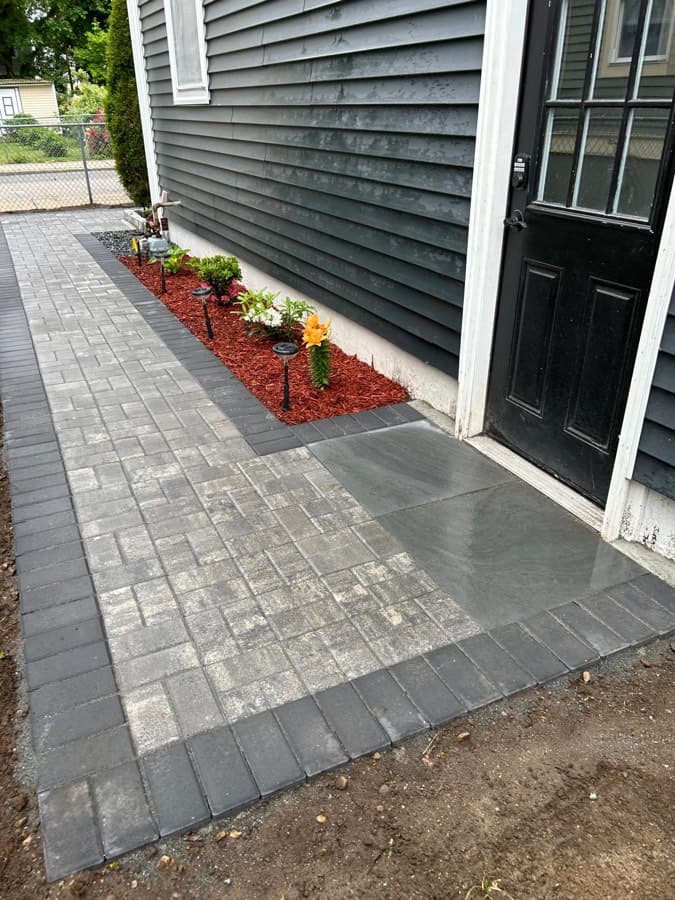
The walkway is the first thing a guest walks on and the first thing a buyer notices from the curb, and in New England it also has to be safe when it is icy and level after the ground freezes and thaws. Levi Construction builds walkways in paver, bluestone, granite and cobblestone that guide the eye to your front door and stay flat and safe through Rhode Island and Massachusetts winters. Airton, the owner, sets the base and the field himself, pitching each path so water and melt run off instead of freezing into a hazard. A good walkway is more than a straight line of stone: it holds its grade, drains at the edges, and reads as an intentional part of the home. With 6 years building paths across RI and MA, we lay walkways that are as sound underfoot as they are on the eye.
A walkway is a pedestrian surface built on a compacted base with a deliberate cross-slope for drainage. Because it only carries foot traffic, the base is shallower than a driveway, but it still needs full compaction and a pitch so water sheds to the sides. Walkways can be laid in interlocking pavers, cut bluestone, natural flagstone, or cobblestone borders, and the edges are restrained so the path holds its lines. Surface texture matters here more than anywhere else, because a walk is where people slip, so the finish is chosen with traction in mind.
Signs You Need Walkways
- Your front path is cracked, uneven or a trip hazard
- Guests and delivery drivers cut across the lawn because there is no clear path
- You want to connect the driveway, front door and backyard with a finished walk
- An old poured or brick walk has heaved and rocks underfoot
- You want to lift curb appeal with a defined, welcoming approach to the door
- You need a path that stays safe and drains when it snows and thaws
Materials & Options
- Interlocking concrete pavers
- Bluestone (natural cleft or thermal finish for traction)
- Granite pavers and setts
- Cobblestone borders and accent bands
- Natural flagstone
- Compacted base aggregate and bedding sand
- Polymeric jointing sand and edge restraint
How We Do It
- 01
Layout and estimate
We stake the route with you, factoring in how people actually move between the drive, door and yard, and give a free estimate with material choices.
- 02
Excavate and pitch
We dig the path and set a cross-slope so meltwater and rain drain to the sides rather than freezing in a low spot across the walk.
- 03
Compacted base
We build and compact the aggregate base so the path stays level and does not ripple after the ground freezes and thaws.
- 04
Set the surface
We lay the pavers or bluestone, cut clean curves and edges, choose a finish with traction, and restrain the edges so the lines hold.
- 05
Joint and clean
We lock the joints with polymeric sand, compact, clean the surface, and walk the finished path with you.
Why Homeowners Choose Levi Construction
Traction chosen on purpose
We pick finishes like thermal bluestone that keep grip when wet or icy, because a front walk is where slips happen in a New England winter.
Holds its grade
A compacted base and a built-in cross-slope keep the path level and draining, so it does not heave into a trip hazard by spring.
Reads as designed
We route the walk to how people actually move and finish the edges cleanly, so it looks like part of the house, not an afterthought.
Walkways: Common Questions
A textured, non-glazed surface with good grip is safest. We often use thermal-finish bluestone or a paver with a rougher face on front walks, and we pitch the path so melt drains to the sides instead of freezing into a sheet across the middle. Traction and drainage together are what keep a walk safe in RI and MA.
A comfortable front walk is usually 3.5 to 4 feet so two people can pass, while garden paths can be narrower. We recommend a width based on how the walk is used and how it looks against the scale of your home, and we go over it during the free estimate.
Not when it is built right. Heave comes from water freezing under a thin base. We excavate to depth, compact the base, and pitch the surface to shed water, so freeze-thaw has nothing to lift. That base work is what separates a walk that lasts from one that ripples.
Cost typically ranges with the length and width of the path and the material you choose, with natural stone like bluestone running above concrete pavers. Because a walkway is a smaller footprint than a driveway, it is often an affordable curb-appeal upgrade. We give a free on-site estimate.
Yes. We regularly tie a front or side walk into patios, stone steps and driveways so the whole approach flows as one design in matching or complementary stone. Building them together keeps the grades and drainage consistent across the property.
Get Your Free Walkways Estimate
Serving Rhode Island and Eastern Massachusetts. The owner is on every job.