
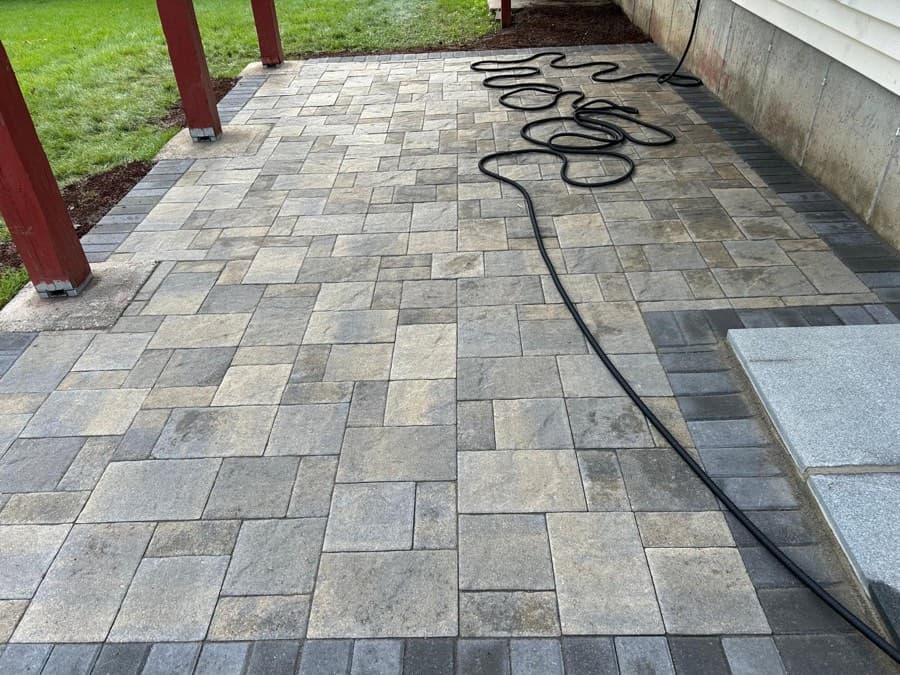
Paver Installation Across RI & Eastern Massachusetts
Interlocking pavers set on a proper base so they never sink, shift or heave after the first winter.
Or call (401) 258-1789
Paver Installation
Pavers only look as good as the base underneath them. In Rhode Island and Massachusetts, the difference between a paver surface that stays flat for 20 years and one that ripples and sinks after two winters is entirely in the excavation, the compaction and the drainage that never shows once the job is done. Levi Construction installs interlocking concrete pavers and natural stone for patios, walkways and driveways, and we build the base to hold through freeze-thaw. Airton, the owner, runs the plate compactor and sets the field himself, so the part you cannot see is done right. We cut clean edges, lock the perimeter with a proper edge restraint, and finish with polymeric sand that resists weeds and washout. With 6 years installing pavers across RI and MA, we treat the base as the real product and the pattern on top as the reward.
Paver installation is a layered system, not just stone laid on the ground. Below the pavers sits an excavated and compacted aggregate base, typically 6 to 12 inches deep depending on whether the surface carries foot traffic or vehicles, topped with a leveling course of bedding sand. The pavers interlock across that surface, held at the perimeter by an edge restraint and locked in the joints with polymeric sand. Because the whole assembly is flexible, individual pavers can be lifted and reset years later, which is why a paver surface is far easier to repair than poured concrete.
Signs You Need Paver Installation
- You want a patio, walkway or driveway that will not crack like poured concrete does
- Existing pavers or brick have sunk, tilted or grown weeds in the joints
- You want a surface you can spot-repair without tearing out the whole slab
- You are upgrading curb appeal before selling and want a high-end finished look
- You need a walking surface that drains instead of pooling after rain
- You want more color, texture and pattern than a plain concrete pad allows
Materials & Options
- Interlocking concrete pavers (many colors, shapes and finishes)
- Natural stone pavers such as bluestone and granite
- Cobblestone for borders and accent bands
- Permeable pavers for surfaces that need to drain in place
- Compacted crushed-stone base aggregate
- Bedding sand leveling course
- Polymeric jointing sand and edge restraint
How We Do It
- 01
Design and estimate
We look at the space, talk through pattern and color, confirm slope for drainage, and give you a free written estimate with the paver options laid out.
- 02
Excavation
We dig out to the depth the surface needs, more for a driveway than a walkway, and cut a slope so water always sheds away from the house.
- 03
Base and compaction
We build the aggregate base in lifts and compact each lift with a plate compactor. This is the step that decides whether the surface heaves. We do not skip it.
- 04
Laying the field
We screed the bedding sand, lay the pattern, cut the perimeter and any curves clean, and set the edge restraint so nothing migrates outward.
- 05
Jointing and final compaction
We sweep polymeric sand into the joints, compact the field, activate the sand, and clean the surface so it is ready to use.
Why Homeowners Choose Levi Construction
The base is built to spec
We excavate and compact to the depth the surface actually needs, so frost heave has nothing to grab. The base is where jobs fail, and where we spend the time.
Easy to repair
Because pavers are a flexible system, a settled or stained paver can be lifted and reset years later. No jackhammer, no full replacement.
Owner-run installs
Airton compacts the base and sets the field himself, so the hidden work under your patio is done to the same standard as the surface you see.
Paver Installation Near You
- Paver Installation in Johnston, RI
- Paver Installation in Providence, RI
- Paver Installation in Cranston, RI
- Paver Installation in Warwick, RI
- Paver Installation in Pawtucket, RI
- Paver Installation in Woonsocket, RI
- Paver Installation in Attleboro, MA
- Paver Installation in Fall River, MA
- Paver Installation in Seekonk, MA
Paver Installation: Common Questions
Pavers sink when the base is thin or poorly compacted, and heave when water freezes under them. We prevent both by excavating to full depth, building the aggregate base in compacted lifts, and pitching the surface so water drains off instead of soaking in. In New England, the base does more work than the paver itself.
For most homeowners in RI and MA, yes. Poured concrete cracks along control joints as the ground moves through freeze-thaw. Pavers flex with the ground instead of cracking, and if one settles or stains you lift and reset it rather than replacing a whole slab.
A properly based paver surface commonly lasts 25 years or more. Concrete pavers are rated for heavy load, and because the system is repairable, the practical lifespan is often longer than a slab that has to be torn out once it cracks.
Cost typically ranges with the square footage, the paver you choose, and how deep the base has to be, since a driveway needs far more base than a walkway. Natural stone runs higher than concrete pavers. We give a free on-site estimate so the price matches your actual layout.
We finish the joints with polymeric sand, which hardens to resist weed growth and washout far better than plain sand. It is not fully weed-proof forever, but it dramatically cuts down what grows and what needs maintenance.
Get Your Free Paver Installation Estimate
Serving Rhode Island and Eastern Massachusetts. The owner is on every job.